
Why the “Disaggregation Revolution” is Incredibly Bullish for India’s E2E Networks

For a long time, the biggest bear case against investing in AI infrastructure companies went like this: “GPUs have the shelf-life of a banana.”
Skeptics argued that because NVIDIA drops massive architectural leaps every two years, an expensive data center filled with current-generation chips would become an obsolete, multi-million-dollar paperweight in no time. For specialized cloud providers, this meant agonizingly short windows to recoup massive capital expenditures (CapEx).
But a major structural evolution is happening in how AI workloads are handled—specifically, the disaggregation of prefill and inference. As venture capitalist Gavin Baker recently highlighted, splitting these processes stretches a GPU’s useful life from 2–3 years to potentially 10 to 15 years.
If you are tracking the Indian stock market, there is one pure-play listed company perfectly positioned to catch the windfall of this architectural shift: E2E Networks Limited (NSE: E2E).
The Core Catalyst: How Prefill Disaggregation Rescues “Older” Tech
When an AI model processes a prompt, it goes through two distinct software phases:
The Prefill Phase: Reads and processes your entire massive block of text/context. This requires intense parallel processing power.
The Decoding/Inference Phase: Outputs the answer one word at a time. This relies heavily on memory bandwidth.
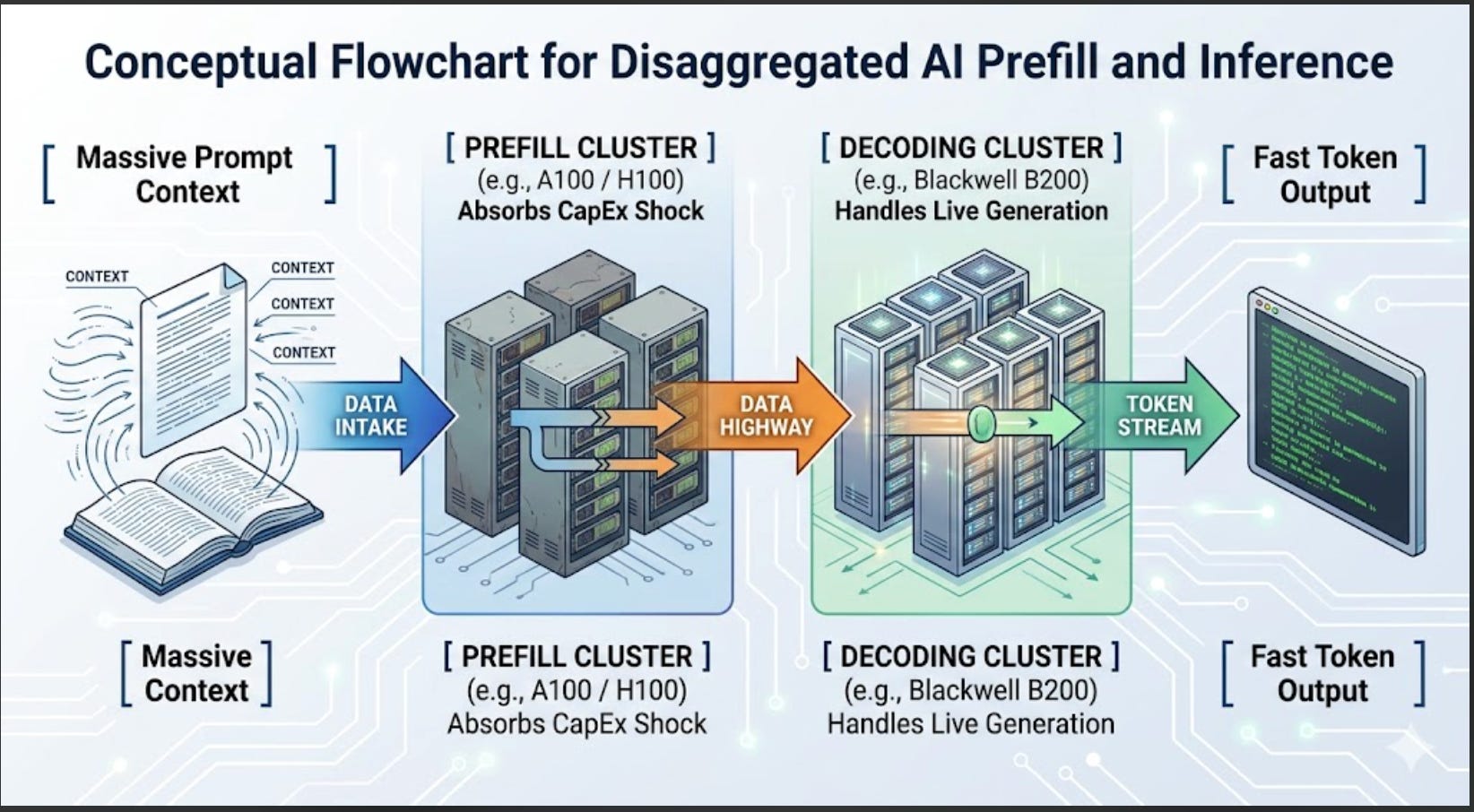
Historically, one GPU did both. Now, data centers are physically splitting them up into different server clusters.
[ Massive Prompt Context ] ──> [ PREFILL CLUSTER ] ──> [ DECODING CLUSTER ] ──> [ Fast Token Output ]
                               (e.g., A100 / H100)       (e.g., Blackwell B200)
                                Absorbs CapEx Shock      Handles Live Generation
Because the prefill phase doesn’t strictly require the bleeding-edge memory bandwidth of tomorrow’s chips, older architectures like the NVIDIA A100 or H100 can handle prefill workloads perfectly. Instead of facing rapid obsolescence, these chips can remain productive, revenue-generating workhorses for over a decade.
Why This Completely Flips the Script for E2E Networks
As an Elite NVIDIA Partner and India’s premier AI-First Cloud Platform, E2E Networks has been aggressively expanding its capacity. Over the last fiscal year, they commissioned over ₹1,185 crores in GPU infrastructure, building out a massive fleet of H100s, H200s, and upcoming Blackwell B200 chips.
Here is why extending the life of these assets is a massive structural win for E2E’s business model and its balance sheet.
1. From Destructive Depreciation to Massive Free Cash Flow
Building a GPU cloud requires heavy upfront borrowing and cash outlay. When the market assumed a GPU was obsolete in 3 years, E2E theoretically had to amortize and recover that massive cost lightning-fast just to break even before the next chip cycle.
With prefill disaggregation, the useful life of E2E’s massive built-out cluster of A100s and H100s stretches dramatically out into the 2030s. Once those chips pay off their initial lease or loan facilities over the first few years, they turn into absolute free-cash-flow printing presses for the remainder of their 10+ year lifespan.
2. Lowering the Cost of Capital via Private Credit
E2E Networks has been actively utilizing debt and lease facilities to fund its ambitious infrastructure expansion.
Because the global risk profile of GPUs is shifting from “highly volatile tech hardware” to “long-term infrastructure assets,” lenders and private credit institutions can look at E2E’s balance sheet with far greater confidence. Lower asset risk means E2E can command significantly better loan terms and a lower cost of capital, allowing them to scale up India’s sovereign AI capacity at a much lower cost.
3. Pricing Dominance for Indian Startups & Enterprises
E2E’s primary edge over global hyperscalers (like AWS or Azure) is its cost efficiency and direct local INR pricing. By running a tiered, disaggregated architecture, E2E can pass massive savings down to the Indian tech ecosystem:
They can offer ultra-cheap, highly efficient Prefill-as-a-Service using their mature A100/H100 clusters.
They can route the generation step to their premium, newly onboarded Blackwell B200 clusters.
This pricing flexibility makes it incredibly difficult for global competitors to undercut them on local soil, all while keeping India’s data strictly sovereign and compliant with local DPDP laws.
The Takeaway
The market has been pricing AI infrastructure companies as if they are high-risk hardware cycles. But as software architectures adapt to save hardware from its own speed, companies like E2E Networks transition from volatile tech plays into something far more lucrative: modern digital utilities.
With an asset base that suddenly lasts three to four times longer than previously feared, E2E Networks’ long-term runway looks structurally stronger than ever.
Disclaimer: This post is for informational and educational purposes only and should not be construed as financial or investment advice. Always consult with a certified financial advisor before making any investment decisions.
Yes. Valid pointers.