
Wakefit Innovations Limited

Wakefit has clearly cracked a scalable niche, but not the Indian home-furnishings market at large. The company has built the strongest current Indian example of a mattress-led, digitally native, omnichannel home brand: it was the largest D2C home-furnishings player in India by FY24 revenue, the largest online mattress player among organized peers, and the only D2C player scaled across mattresses, furniture, and furnishings with each category above ₹1 billion in FY24 revenue. At the same time, the total market remains so large and fragmented that Wakefit’s FY24 revenue still represented only about 0.33%–0.35% of India’s total home-furnishings market and, by my estimate, just 3.5%–3.9% of the total mattress market. In other words, Wakefit has cracked the go-to-market model, not the market itself.
Wakefit reported FY26 revenue from operations of ₹14,889 million, i.e. ₹1,489 crore. In USD, that is approximately $155 million. Whereas the TAM is really big, they are just scratching the surface.
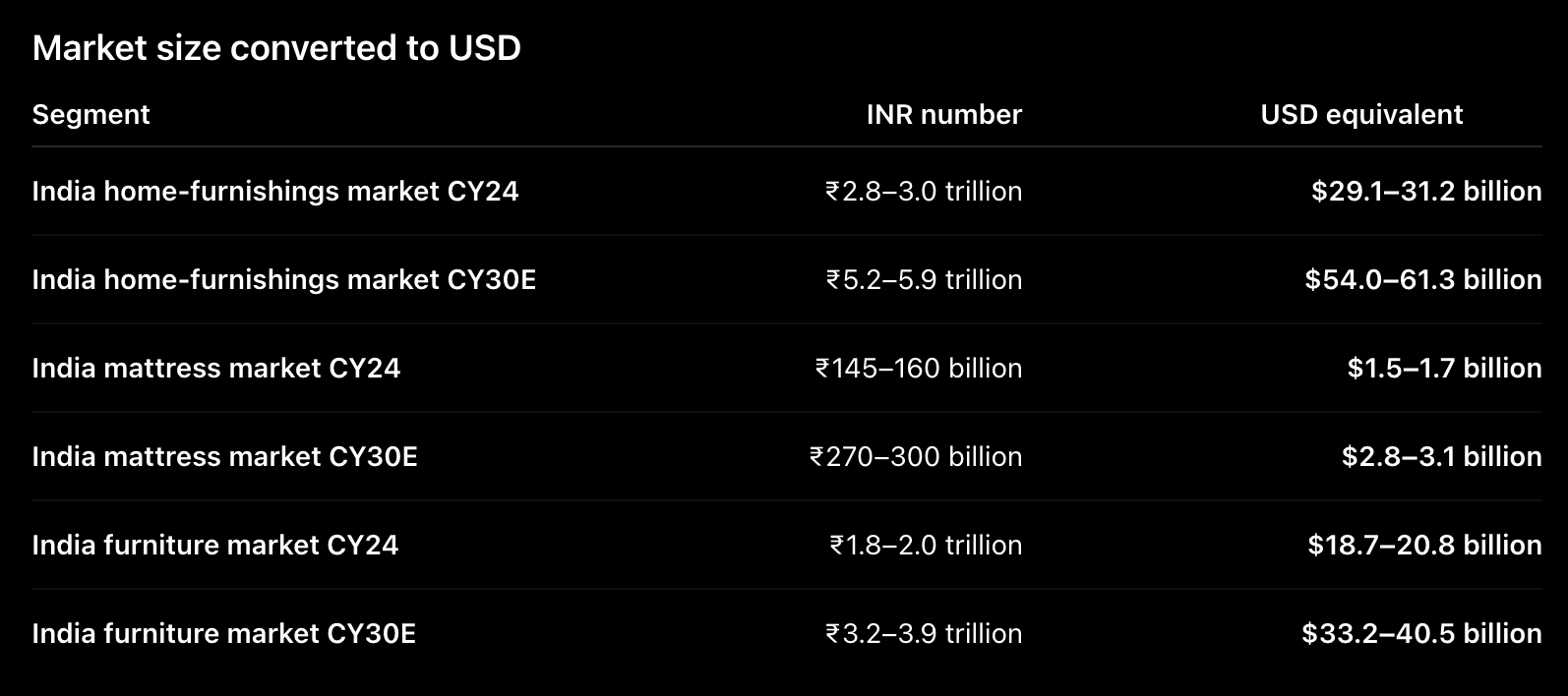
One can argue this is not winner take all market but can Wakefit become 10x bigger from current 0.33%–0.35% of India’s total home-furnishings market to 3.5% of home furnishing market ? 4x bigger from 3.5%–3.9% of the total mattress market to 13-15% of matter market in 10 years from now ? i think its possible and remember the market itself is growing 10-11% CAGR. One can argue this is a tall task too even then growing 15-20% CAGR in the next 10 years i think is possible we will have to take that and see if wakefit is pricing in what growth today.
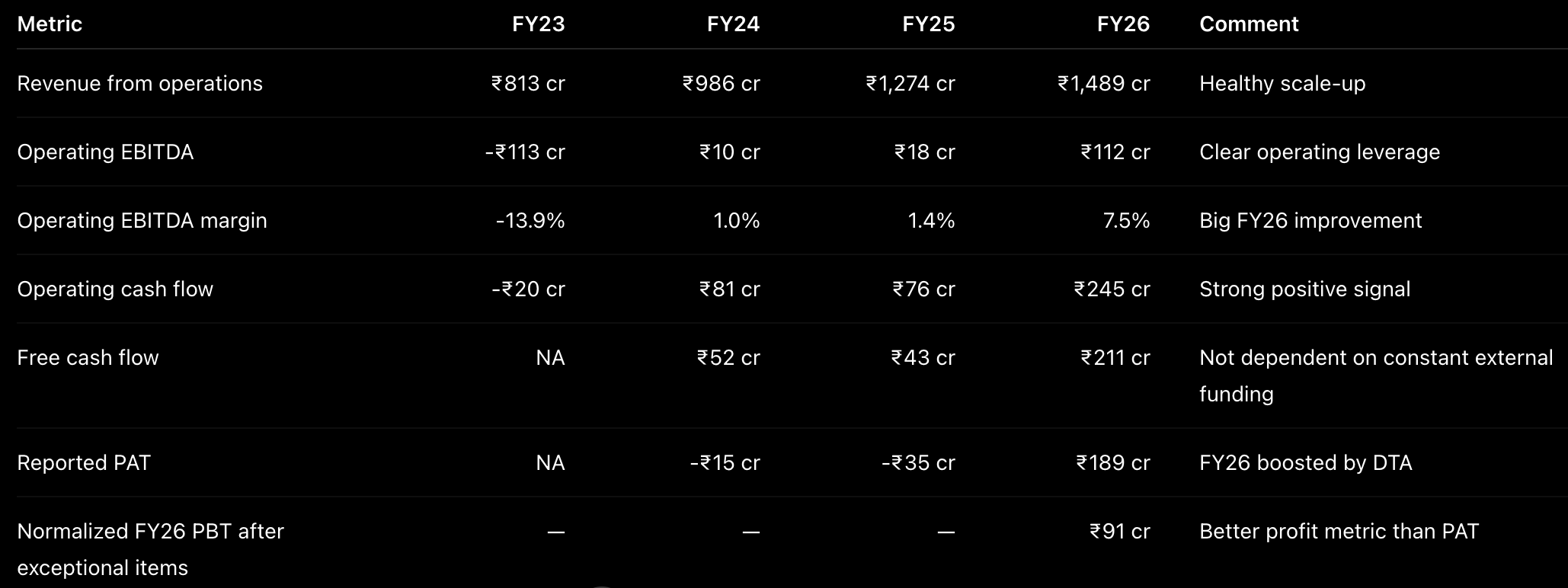
Wakefit’s growth no longer looks like pure cash-burn growth. Revenue has compounded well, operating EBITDA has turned meaningfully positive, and most importantly, operating cash flow has improved sharply. FY26 revenue from operations was ₹1,489 crore, operating EBITDA was ₹112 crore, PBT after exceptional items was ₹91 crore, and reported PAT was ₹189 crore — though FY26 PAT includes the benefit of a ₹98 crore deferred tax asset, so headline PAT overstates clean profitability.
Market Cap₹ 4,422 Cr.
Receivables: rising fast, but still not alarming.
DSO means “days sales outstanding” — in simple words, how many days of sales are stuck as unpaid customer/channel dues.
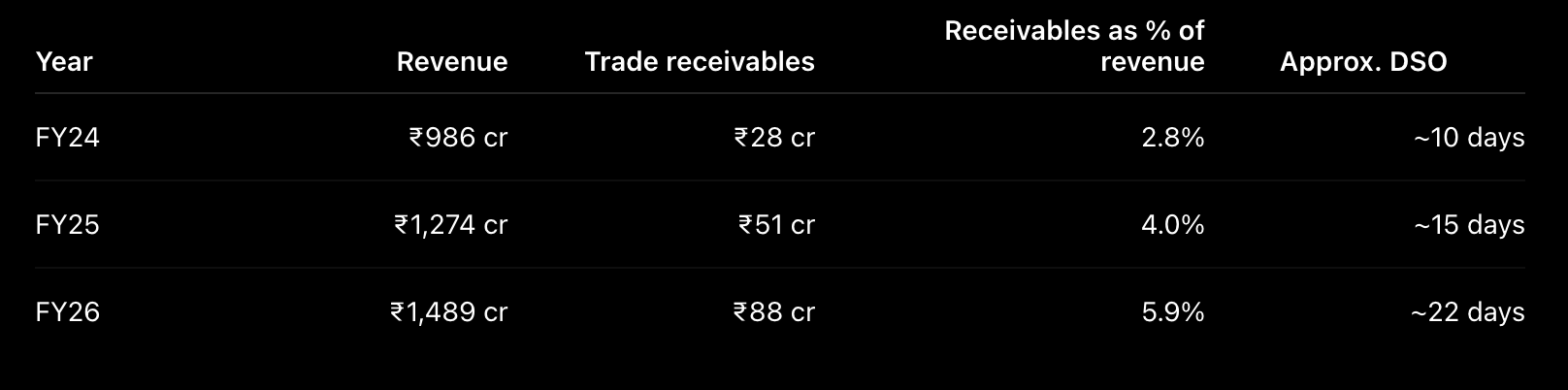
Above table is a sign of very well run business.
Why is DSO still so low? Because Wakefit’s model is still heavily D2C / owned-channel / online-led, where the customer typically pays upfront or near-upfront. Marketplace receivables also usually settle quickly. Receivables become a bigger issue when sales move through MBOs, distributors, offline retail partners, institutional sales, or credit-based B2B channels. So a 10–22 day DSO is actually quite low for a consumer business with offline expansion. I think as they keep expanding business more offline we will see DSO inching up but still not by much due to their business model which we will talk about later.
My bottom line is that Wakefit looks investable as a scaled omnichannel consumer brand with improving unit economics and genuine free-cash-flow potential, but it should be underwritten as a mid-single-digit sustainable margin business, not a structurally high-margin consumer platform. The moat is real but moderate: brand + supply chain/process design + omnichannel distribution + customer data. There is no true network effect. Sustainable profits look plausible; structurally high-return, very high-margin profits look less plausible. (we will consider this while valuing the business)
The competitive structure is fragmented in this market as it can never become winner take all due to no network effect - but the better way to think about it is by model, not just by brand list. Traditional incumbents such as Sheela Foam / Sleepwell / Kurlon dominate the organized mattress market through broad dealer networks. Newer Indian peers such as Duroflex / Sleepyhead compete across sleep and adjacent categories. Furniture-led players such as IKEA, Royaloak, Pepperfry, Urban Ladder, Godrej Interio, and Home Centre compete on assortment, price architecture, experience, and real-estate footprint. The DRHP specifically identifies Wakefit, Duroflex, Comfort Grid Technologies, and Urban Ladder as important D2C players in the home-furnishings segment, while also listing major organized peers such as Sheela Foam, Ikea India, D’Décor, Royaloak, Lifestyle International, and Godrej & Boyce.
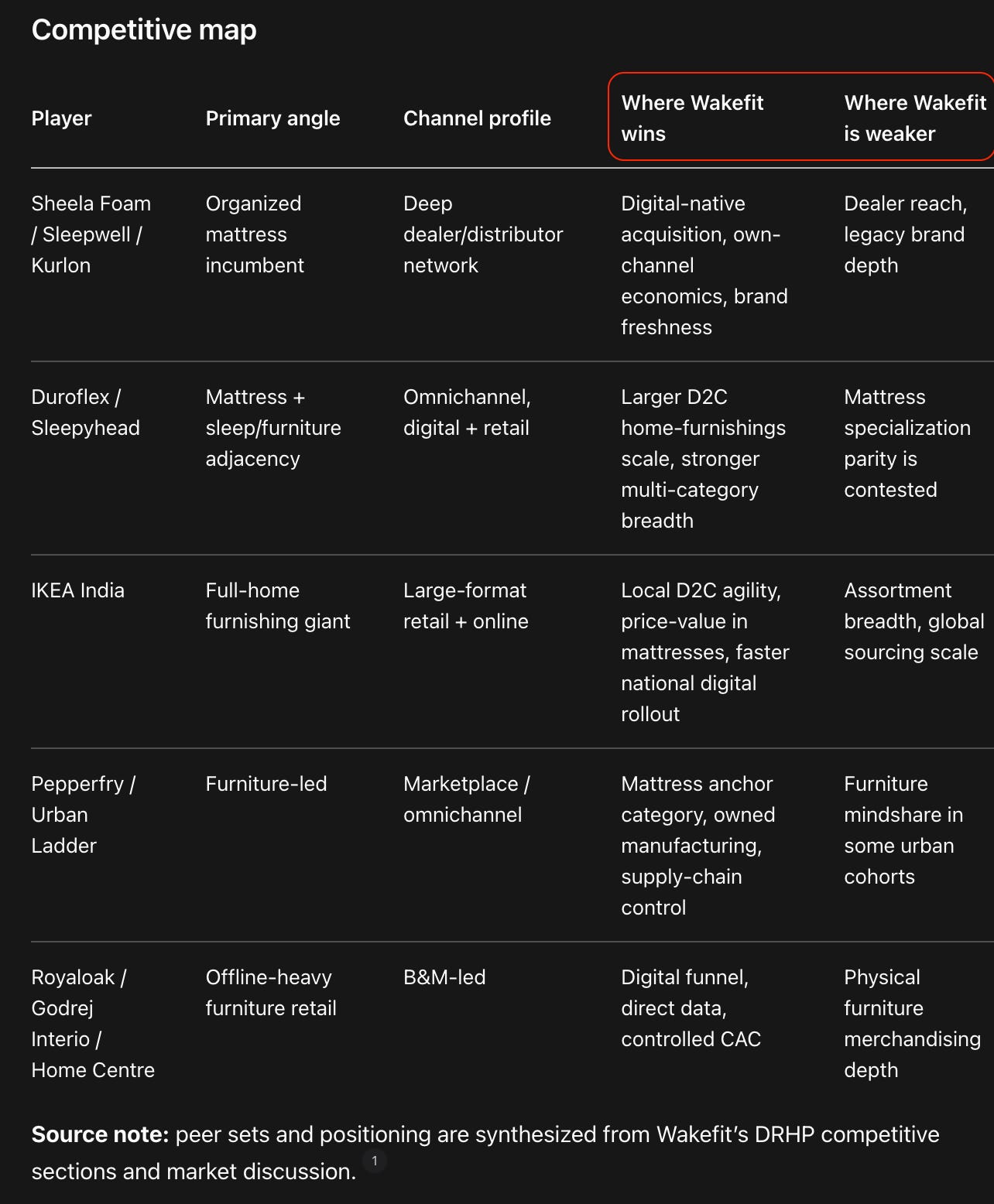
The more I look at the industry, the more it looks like a fragmented, competitive, non-winner-take-all market. That makes the upside possible, but not obvious enough for me to spend more time on it.
I think wakefit has the potential to do good but honestly, this is the point where I start losing interest in the thesis — not because Wakefit is a bad company, but because the industry itself is highly competitive and fragmented. Mattresses, furniture and home furnishings are not winner-take-all markets. Many brands, offline retailers, local players, marketplaces, and large incumbents can coexist. So even if Wakefit grows, I am not sure the business will enjoy the kind of deep moat or dominant economics I look for. And as investors, we do not need to make money from every listed company. We only need a handful of exceptional businesses bought at sensible valuations to create serious wealth.
END OF ANALYSIS : I’ll come back with some better business next time.