

📝 Summary
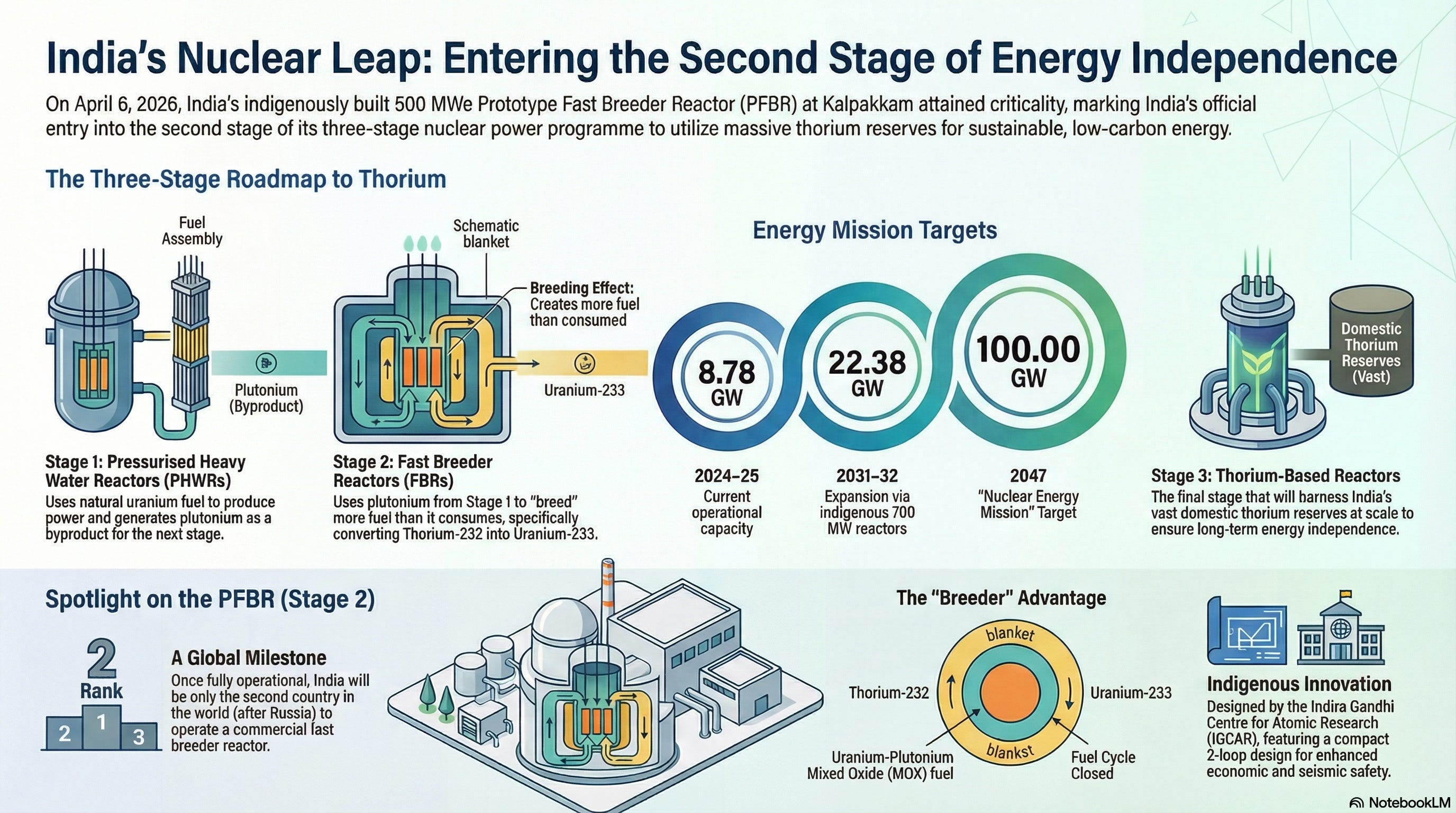
This podcast explores a historic milestone in India’s nuclear journey—the Prototype Fast Breeder Reactor (PFBR) achieving first criticality on April 6, 2026.
At its core, the episode explains a fundamental limitation of traditional energy systems: they consume fuel in a one-way process, leaving behind waste. Nuclear breeder technology challenges this constraint by creating more fuel than it uses, effectively turning waste into a resource.
The discussion breaks down complex nuclear physics in simple terms—how conventional reactors use only ~1% of uranium, while fast breeder reactors can utilize up to 60–70% by converting non-fissile uranium-238 into plutonium-239. This process, called transmutation, enables a self-sustaining fuel cycle.
A key engineering innovation is the use of liquid sodium as coolant, which allows fast neutrons to maintain the breeding process. However, this introduces massive challenges due to sodium’s extreme reactivity, making reactor design highly complex and risky.
The podcast also examines why many advanced economies—including the US, Japan, France, and Germany—abandoned breeder reactor programs due to cost, safety, and political concerns. In contrast, India persisted despite decades of delays and cost overruns.
The reason is strategic:
India has limited uranium but one of the world’s largest thorium reserves (~25%), and breeder reactors are essential to unlocking this resource. This forms the backbone of India’s long-term three-stage nuclear program, designed to achieve energy independence over generations.
If successful, this roadmap could deliver:
Hundreds of years of clean, stable energy
Reduced dependence on imported fuels
A viable path to net-zero emissions
The ability to burn existing nuclear waste as fuel
The episode ultimately frames the PFBR not just as a power plant, but as a civilizational bet on long-term thinking—a rare example of multi-generational planning aimed at solving energy, climate, and geopolitical challenges simultaneously.


