
The El Niño Trade: What If The Weather Becomes The Market?
For Indian investors trying to understand 2026, monsoon risk, edible oils, fertilizers, and why an Iran crisis can make the whole thing uglier.

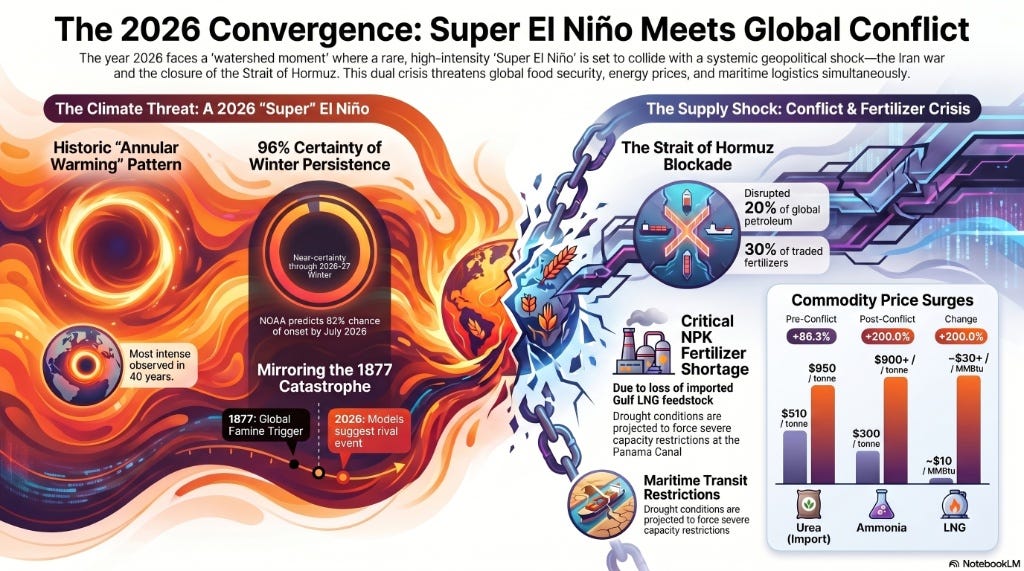
El Niño 2026 is not yet 1877. But if the Pacific, Indian monsoon, and Middle East fertilizer shock all go wrong together, this becomes one of those macro trades where weather quietly walks into your portfolio and starts moving prices.
Not necessarily Nifty crashing. Not necessarily some apocalypse trade. But food inflation, agri commodities, fertilizer costs, rural demand, government intervention, and sector rotation — all of that can become very real.
And as investors, we do not need to predict the exact rainfall in Barabanki or Anantapur. We need to know where the risks are building, what the market might price first, and where we should not be stupid.
So let us unpack it.
First: what the hell is El Niño?
El Niño is basically a warming of the central and eastern Pacific Ocean near the equator.
Normally, winds push warm water toward the western Pacific. During El Niño, those winds weaken, warm water shifts eastward, and the entire global weather machine gets disturbed.
For India, the big issue is this:
El Niño often weakens the Indian monsoon.
Not always. Not mechanically. Not with 100% certainty. But enough times that India, inflation, agriculture, and markets have to pay attention.
Why? Because India is still a monsoon economy pretending to be a services economy.
The monsoon gives roughly 70% of India’s annual rainfall. Agriculture may be “only” around 18% of GDP, but rural livelihoods, food prices, political pressure, fertilizer demand, FMCG volumes, two-wheeler demand, tractors, banks, NBFCs, sugar, edible oil, rice, pulses — all of this is connected to rain.
So when the Pacific starts warming, an Indian investor should not say, “Nice science bro.”
He should say:
“Okay, what does this do to food, fertilizer, rural demand, and inflation?”
What are recent reports saying about 2026?
The official forecast stack is now leaning strongly toward El Niño developing in 2026.
NOAA says El Niño is likely to emerge around May–July 2026 and continue through the Northern Hemisphere winter. IRI’s forecast also gives high probabilities of El Niño through the rest of 2026. ECMWF/Copernicus has flagged a strong signal in its seasonal forecast. Australia’s Bureau of Meteorology says the Pacific is warming, with the event likely at least moderate and possibly strong. IMD has already forecast India’s 2026 southwest monsoon at around 93% of the long-period average, which is below normal.
Now, 93% of LPA is not a famine forecast. It is not 1877. It is not “sell everything and buy rice bags.”
But it means the weather risk has moved from background noise to macro variable.
And in markets, that matters.
Because once the market starts believing that rainfall may disappoint, the first moves usually happen in expectations: edible oils, pulses, sugar, fertilizers, rural consumption, and inflation-sensitive sectors.
The market does not wait for the farmer to harvest. It starts repricing the probability tree.
Why is everyone suddenly talking about 1877?
Because 1877 was one of the nastiest El Niño years in recorded history.
The 1877–78 El Niño was among the strongest known events. Historical climate reconstructions show very high sea-surface temperature anomalies in the Niño regions. For India, the outcome was brutal: IMD’s drought climatology places 1877 as India’s worst all-India drought year, with about 33% deficiency in Indian summer monsoon rainfall.
That is massive.
To put it simply: if normal monsoon is the economy’s water salary, 1877 was like the salary got cut by one-third.
And remember, 1877 was not just a climate event. It was tied to famine, crop failure, colonial-era administrative failure, grain stress, and huge human suffering.
So when someone says “1877-like El Niño,” do not treat it as just a spicy Twitter phrase. It is a very high bar.
Is 2026 really going to be like 1877?
My honest answer: probably not as the base case. But the tail risk is real.
The current official forecasts suggest high probability of El Niño. Some models show a meaningful chance of a strong event. But to become truly 1877-like, we need more than just “El Niño.”
We need:
A very strong Pacific warming event.
The wrong spatial pattern — especially eastern-Pacific warming that is more hostile to India’s monsoon.
Strong ocean-atmosphere coupling.
Poor Indian rainfall distribution during sowing months.
No offset from positive Indian Ocean Dipole or other supportive factors.
Policy and supply-chain stress making food/fertilizer shocks worse.
That is a lot of things going wrong together.
So my working number would be this:
Chance of El Niño in 2026: high.
Chance of strong El Niño: meaningful.
Chance of a truly 1877-like India outcome: maybe 10–25%, with my base estimate around 15%.
This is not an official probability. This is an investor’s probability.
Meaning: not high enough to panic, but high enough that ignoring it is dumb.
The real India risk: not just less rain, but bad timing
Investors often make one mistake with monsoon.
They look only at the all-India rainfall number.
But agriculture does not care only about the final score. It cares about the over-by-over scorecard.
A monsoon can end at 95% of normal and still hurt farmers if rain is late, badly distributed, or missing during sowing windows.
For kharif crops, June and July matter a lot. If rains arrive late or remain patchy, sowing gets delayed. If there is too much rain later, it may not fully repair the damage. For rabi crops, weak monsoon means lower soil moisture and weaker reservoir recharge.
So the sequence matters:
El Niño → weak or uneven monsoon → sowing stress → lower crop output → food inflation → policy response → market rotation.
That is the trade chain.
Crop impact: where the pain can show up
Rice
Rice is the big one.
Kharif rice depends heavily on monsoon rains. Weak rainfall can delay transplanting, reduce acreage, or hurt yields. If rice gets hit badly, the government becomes very active because rice is politically sensitive.
Expect export controls, stock limits, procurement action, or import/export policy changes if stress builds.
For investors, rice itself is hard to trade cleanly, but rice stress affects inflation expectations and rural income.
Pulses
Pulses are always a sensitive inflation item in India.
Tur, urad, moong, chana — these can move violently when rainfall disappoints. India is structurally vulnerable in pulses because domestic supply is not always enough and imports cannot always solve the problem instantly.
A bad monsoon can first hurt kharif pulses and later affect rabi pulses through soil moisture.
So pulses are an inflation risk and a political risk.
Oilseeds
This is where things get interesting for investors.
Soybean, groundnut, mustard/rapeseed — these are vulnerable to rainfall and acreage patterns. If domestic oilseed output disappoints, India needs more edible oil imports.
India already imports a large share of its edible oil needs. So if domestic oilseed output is weak and global edible oil prices are firm, India gets squeezed.
This is why I think the edible oil complex may be one of the cleaner ways to think about the El Niño trade.
Sugarcane
Sugarcane is water-hungry.
It is partly irrigated, yes, but reservoir levels and groundwater matter. If the monsoon disappoints, sugarcane yields and recovery rates can suffer. That can tighten sugar supply and affect sugar company earnings, export policy, ethanol blending economics, and government intervention.
Sugar stocks are never just sugar stocks. They are weather + politics + ethanol + working capital + cyclicality.
Handle with care.
Wheat
Wheat is rabi, so people may think El Niño does not matter.
But weak monsoon can reduce soil moisture and reservoir availability going into the winter crop. If that is followed by heat stress near harvest, wheat becomes vulnerable.
So wheat is a second-round risk.
Not the first domino, but definitely in the chain.
Now add Iran war and fertilizer shortage: this is where the story becomes dangerous
A normal El Niño year is already enough to create food inflation risk.
But 2026 has another ugly layer: Middle East conflict and fertilizer stress.
India depends heavily on imported fertilizer and fertilizer inputs. Urea, DAP, ammonia, sulfur, LNG, shipping routes — a lot of this has Middle East exposure.
If the Iran crisis disrupts the Gulf, Strait of Hormuz, LNG, freight insurance, or fertilizer shipments, then India faces a double problem:
Bad weather raises the need for good farm execution.
But fertilizer becomes expensive or harder to source exactly when farmers need it.
That is the bad combination.
Think of it like this. In a weak monsoon year, farmers need timely sowing, timely fertilizer application, and good irrigation support. But if fertilizer prices spike, imports are delayed, or subsidies become stretched, then the system becomes fragile.
The government can absorb some of this through subsidies. But subsidy is not magic. It hits fiscal math, working capital, company receivables, and policy uncertainty.
If urea, DAP, ammonia, sulfur, LNG, and freight all remain stressed, then El Niño does not just become a crop story. It becomes:
food inflation + subsidy burden + current account pressure + rural demand risk + corporate margin risk.
That is much more market-relevant.
How to trade this as an Indian investor
Let me be very clear.
Do not YOLO into some random agri stock because you read “El Niño” on Twitter.
Weather trades are dangerous because forecasts change, government intervenes, and liquidity can vanish.
But there are sensible buckets to watch.
1. MCX crude palm oil / edible oils
This is probably one of the cleaner commodity expressions.
Why?
Because India imports a lot of edible oil. If Indian oilseed output is threatened and global palm/soy/sunflower oil markets are tight, edible oil prices can react.
MCX crude palm oil can become interesting if:
monsoon onset is delayed,
rainfall distribution is weak in oilseed belts,
soybean/rapeseed acreage looks stressed,
palm oil imports remain low because prices are high,
global edible oil prices stay firm.
But this is not a blind long. This is a staged trade.
The better framework:
Starter position on forecast confirmation.
Add only if June–July rainfall disappoints.
Add again only if crop data confirms stress.
Exit or cut if monsoon distribution improves.
Weather trades punish ego.
2. Fertilizer stocks
This bucket is tricky.
Many people think fertilizer shortage means fertilizer stocks go up. Not always.
There are two different stories:
Urea players
Regulated urea producers can be defensive because government wants supply security. But upside may be capped by regulation and subsidy delays.
DAP/NPK/import-linked players
These can face margin pressure if imported inputs spike and subsidy does not adjust fast enough. Companies with better sourcing, lower working capital stress, and strong balance sheets are safer.
So the trade is not “buy all fertilizer stocks.”
The trade is:
Who benefits from supply security, and who gets hurt by imported input inflation?
That distinction matters.
3. Sugar stocks
Sugar can benefit from tighter supply expectations, but government intervention is a permanent overhang.
If cane output weakens, sugar prices can rise. But the government may restrict exports, control prices, or adjust ethanol policy.
So sugar is tradable, but not clean.
The market often gives sugar stocks a weather premium, then takes it away when policy enters the room.
4. Rural demand stocks
This is the negative side.
If monsoon disappoints badly, rural income weakens. That can hurt:
two-wheelers,
tractors,
rural FMCG,
microfinance,
some NBFCs,
discretionary consumption in rural/semi-urban markets.
But again, not all at once. If government support increases, some of the demand shock may be cushioned.
The market will first react to rainfall and sowing data, then to company commentary.
5. Food inflation beneficiaries and losers
If food inflation rises, the obvious losers are consumers and policymakers.
But markets rotate.
Companies with pricing power can survive. Companies with raw material exposure can get squeezed. Quick-service restaurants, packaged food, staples, edible oil processors, dairy, poultry feed, agrochemicals — all need to be analyzed separately.
Inflation does not hit everyone equally.
What about the stock market historically?
This is important.
El Niño does not automatically mean Nifty falls.
Look at recent history.
In 2014, El Niño risk was present, but Indian equities rallied massively because the market was driven by political change, reform hopes, and valuation rerating.
In 2015, the monsoon was weak and El Niño was stronger; the market struggled.
In 2018–19, weak El Niño conditions did not create a massive equity disaster.
In 2023–24, we had a strong global El Niño, but Indian equities still did well because domestic liquidity, capex, earnings, and macro confidence dominated.
So the lesson is:
Do not trade El Niño through a simple “short Nifty” button.
That is too crude.
The better trade is sector rotation.
Historically, El Niño matters more through:
food inflation,
rural demand,
rate expectations,
fertilizer subsidy pressure,
commodity prices,
crop-specific shortages,
government policy response.
The index may ignore El Niño if liquidity and earnings are strong. But sectors will not ignore it.
My investor playbook for 2026
Here is how I would think about it.
Phase 1: Now to monsoon onset
This is the probability phase.
Track NOAA, IMD, IRI, BoM, ECMWF updates. Watch whether the forecast keeps strengthening. Do not over-position yet.
Best trades: small, risk-defined, optionality-style trades.
Phase 2: June to early July
This is the sowing phase.
Watch monsoon onset, rainfall distribution, reservoir levels, and sowing data.
If rains are late or patchy, edible oils, pulses, fertilizer, and sugar become more interesting.
If rains are decent, reduce the weather panic trade.
Phase 3: July to August
This is the confirmation phase.
By now, the market will know whether this is just a scary forecast or a real crop problem.
This is where bigger money moves.
If rainfall deficit persists, then commodity and sector trades become more credible.
Phase 4: September onward
This becomes a policy trade.
By harvest time, the question shifts from “Will crops be hit?” to “What will the government do?”
Expect possible moves on:
imports,
export bans,
stock limits,
fertilizer subsidies,
edible oil duties,
rice/wheat buffer stocks,
sugar exports,
ethanol policy.
Policy can make or break the trade.
What I would personally watch every week
If I had to keep a simple dashboard, I would track:
Niño 3.4 sea-surface temperature anomaly.
NOAA/IRI ENSO probability updates.
IMD monsoon progress and rainfall departure.
Rainfall distribution by region, not just all-India number.
Reservoir levels.
Kharif sowing data.
Palm oil, soybean oil, and sunflower oil prices.
Urea, DAP, ammonia, sulfur prices.
INR and crude oil.
Government policy announcements on food and fertilizer.
This is enough. You do not need to become a meteorologist.
You just need to know whether the risk is increasing or fading.
The 1877 comparison: useful, but dangerous
1877 is useful as a warning.
It tells us what a truly extreme El Niño plus monsoon failure can do.
But it is dangerous if we use it as clickbait.
Because 2026 is not yet 1877. The Pacific has not yet delivered the same realized extreme. India’s rainfall has not yet collapsed. Forecasts are probabilities, not destiny.
So the intellectually honest view is:
Base case: below-normal or stressed monsoon risk.
Bull case for India: El Niño develops but monsoon distribution remains manageable, possibly helped by other ocean patterns.
Bear case: strong eastern-Pacific El Niño + poor rainfall distribution + fertilizer shock + energy/freight stress.
Disaster tail: 1877-style monsoon failure. Low probability, high impact.
That is how investors should think.
Not binary. Probabilistic.
Final thought over the beer
The mistake most investors make is they wait for the headline.
“Drought declared.”
“Food inflation spikes.”
“Government bans exports.”
“Fertilizer subsidy increased.”
“Palm oil imports surge.”
By then, the first move is often gone.
The smarter way is to watch the chain before the headline:
Pacific warming → monsoon risk → sowing stress → crop balance → import need → price move → policy response → equity rotation.
That is the trade.
And the scariest part of 2026 is not El Niño alone.
It is El Niño meeting a world where fertilizer, energy, freight, and geopolitics are already tight.
Weather can hurt crops.
War can hurt fertilizer.
Together, they can hurt food security.
For Indian investors, this is not a reason to panic.
It is a reason to prepare.
Keep position sizes sane. Respect government intervention. Do not use leverage like an idiot. And remember: in weather trades, the market does not reward the person with the strongest opinion. It rewards the person who updates fastest when the rain actually arrives — or does not.
Not investment advice. This is a framework for thinking about risk, commodities, and sector rotation. Weather and commodity trades can reverse violently.
What about RAC industry as a trade ?